
Sports Performance & Golf Training
Most performance training is generic: the same program handed to everyone, regardless of what your body can actually do. That works until it doesn't; you hit a mobility limitation or a stability gap that no amount of effort will train around, and either progress stalls or something gets hurt.
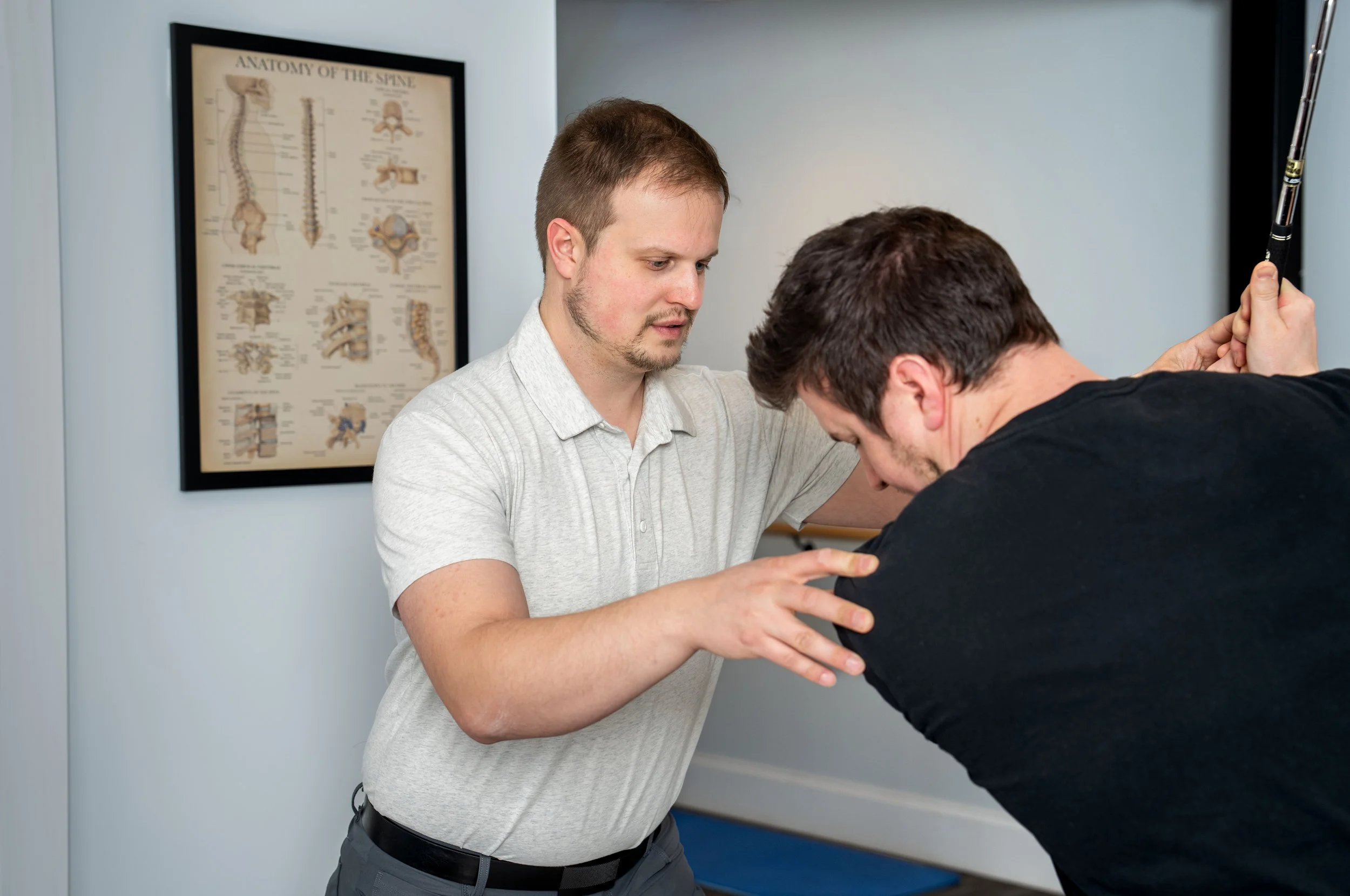
At Back Nine, performance training starts with an assessment, not a workout plan. We identify the specific physical limitations affecting your movement, whether that's hip rotation limiting your golf swing, single-leg stability affecting your running mechanics, or a strength imbalance putting you at risk, and build a program that actually addresses it. Because it's led by a Doctor of Physical Therapy, we're equipped to catch things a standard trainer isn't trained to see, and adjust the plan in real time as you progress.
Whether you're a golfer chasing more distance and fewer injuries, or an athlete trying to build strength and durability for your sport, the goal is the same: figure out what's actually limiting you, then train it directly.
Frequently Asked Questions
What makes this different from a normal gym program or personal trainer?
A trainer can push you through a hard workout. What most trainers aren't trained to do is identify why your hips don't rotate the way they should, why one side compensates for the other, or when a limitation is actually a red flag for something structural. At Back Nine, that evaluation piece comes first, from a Doctor of Physical Therapy, so the program is built around your actual limitations instead of a generic template.
What is a TPI screen, and do I need one if I'm not a serious golfer?
TPI (Titleist Performance Institute) is a screening system that evaluates how your body moves in relation to the golf swing, mobility, stability, strength, and balance, to identify what's limiting your swing or putting you at risk of injury. You don't need to be scratch or even a regular player to benefit. If golf is something you do and want to keep doing without your back or hip flaring up every few rounds, the screen tells us exactly where to focus instead of guessing.
I don't have pain right now. Is this still worth it?
Yes, and honestly, this is often the best time to start. Performance training isn't just injury rehab; it's addressing the limitations before they turn into pain, and building the strength and mobility that actually shows up in how you move, swing, or play. Golfers commonly come in for more clubhead speed or distance and leave with both that and a body less likely to break down mid-season.
How is this different from Physical Therapy?
Physical therapy is generally about resolving pain or recovering from an injury. Sports performance training picks up from there, or starts fresh if you're not dealing with pain at all, and focuses on building strength, power, and movement capacity for your sport. Many patients move from PT into performance training once pain is resolved, using the same clinician and the same understanding of their body, instead of starting over with someone new.
What does a typical program look like?
It starts with a movement assessment (a TPI screen for golfers, or a broader movement and strength evaluation for other athletes) to identify your specific limitations. From there, sessions combine targeted mobility work, strength training, and movement retraining aimed at those limitations, not a one-size-fits-all circuit. Programs are typically structured in packages so progress can be tracked and the plan adjusted as you improve.
Will this actually add distance to my golf swing?
Often, yes, but not through a swing tip. Distance is largely a function of how efficiently your body can rotate, load, and transfer force, things like hip and thoracic rotation, stability through the lead leg, and overall power output. When those physical limitations improve, more speed usually follows, and it tends to hold up better under repeated rounds than a mechanical change alone.
Do you work with athletes outside of golf?
Yes. The same principle applies to any sport: find the physical limitation most likely to cause injury or limit performance, then train it directly. That could be single-leg stability for a runner, rotational power for a baseball or hockey player, or general strength and movement quality for someone getting back into consistent training.
I'm not an "athlete." Is this still for me?
This program is for anyone who wants to move better and build real strength, competitive athlete or not. If you're active, want to stay that way, and want a program built around how your body actually moves rather than a generic plan, this is the right fit.